Level 3 Integration Walkthrough
2019 NCEA Level 3 Integration Question 2(b)
2019 Paper
Question
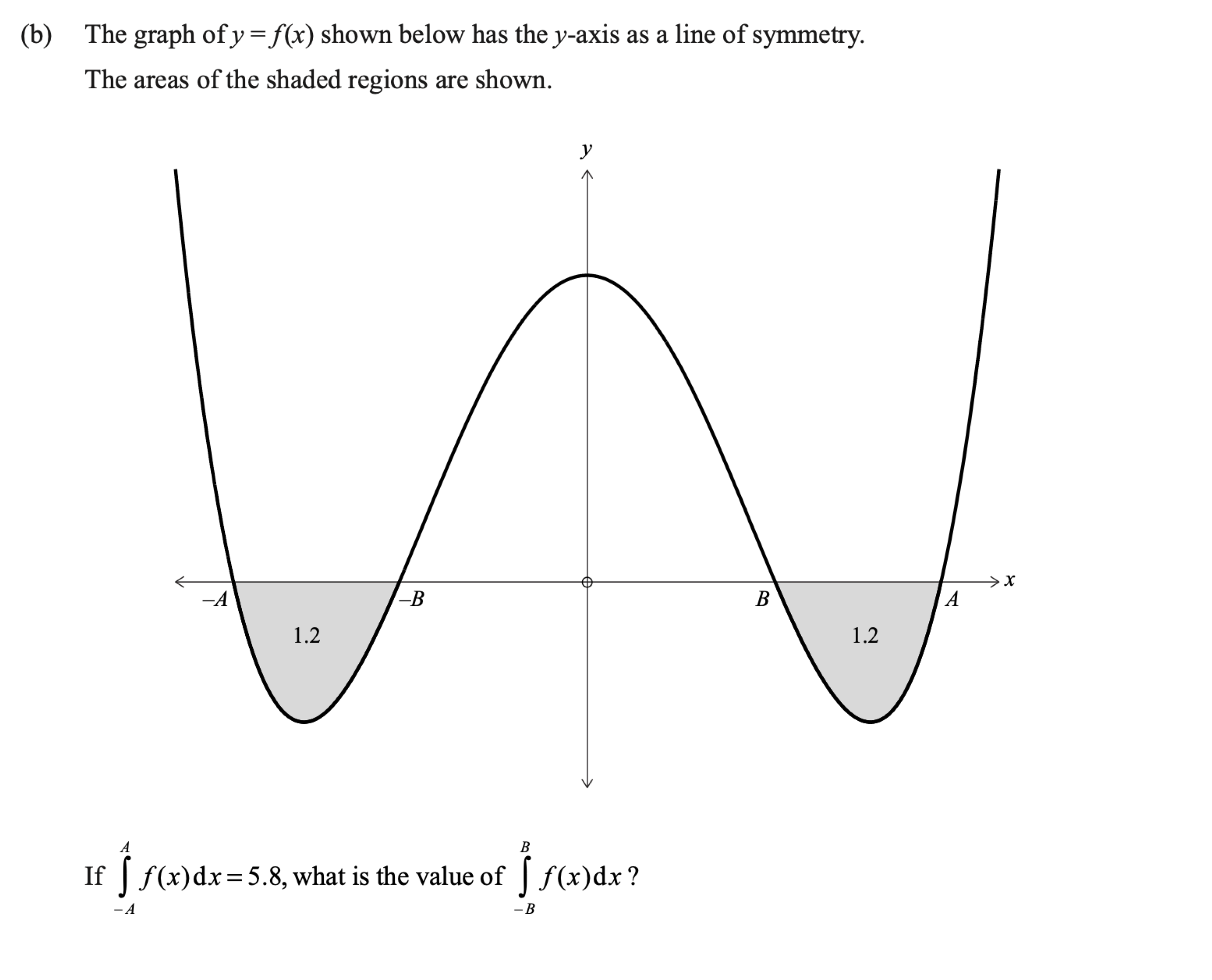
The graph of \(y=f(x)\) has the \(y\)-axis as a line of symmetry. It crosses the \(x\)-axis at \(-A,-B,B,A\). Each shaded region below the axis, from \(-A\) to \(-B\) and from \(B\) to \(A\), has area \(1.2\).
If \(\int_{-A}^{A}f(x)\,dx=5.8\), what is the value of \(\int_{-B}^{B}f(x)\,dx\)?
First walkthrough idea
Focus to try first
Use signed area: the full integral includes two negative shaded regions, while \(\int_{-B}^{B}f(x)\,dx\) excludes them.
Step 1
Identify the signed pieces
The two shaded side regions are below the \(x\)-axis, so each contributes \(-1.2\) to the signed integral.
Show the first step’s working
Walkthrough overview
What this question practises
This 2019 walkthrough is part of AS91579 — Apply integration methods in solving problems.
Method: Using signed areas and symmetry on a graph.
This is Question 2(b) from the 2019 NCEA Level 3 Integration paper for AS91579 — Apply integration methods in solving problems. Use the guided hints to practise the method before revealing the full working.
Calc.nz is an independent learning resource. Compare questions, diagrams, and assessment information with the official NZQA resources for AS91579.
Page updated .
Learning summary
Review the method, not only the answer
This walkthrough helps you practise using signed areas and symmetry on a graph. Use the hints to plan the method, then repeat the question without hints and check each step.
Common mistake to avoid
Check intersections, signs, and whether the question asks for signed area or total geometric area.