Level 3 Integration Walkthrough
2020 NCEA Level 3 Integration Question 3(d)
2020 Paper
Question
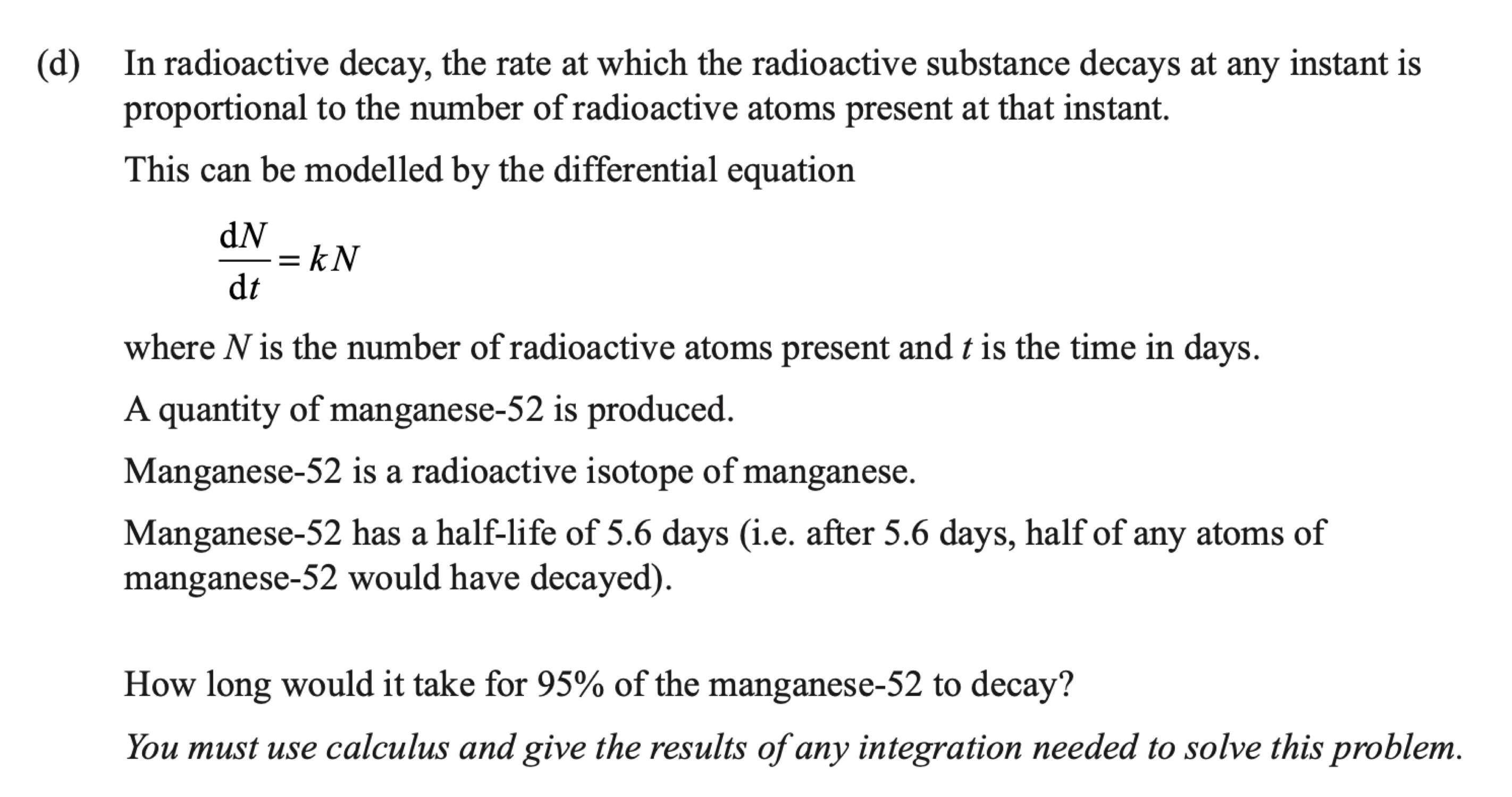
In radioactive decay, the rate at which a radioactive substance decays at any instant is proportional to the number of radioactive atoms present at that instant. This can be modelled by \(\frac{dN}{dt}=kN\), where \(N\) is the number of radioactive atoms present and \(t\) is the time in days.
A quantity of manganese-52 is produced. Manganese-52 is a radioactive isotope of manganese and has a half-life of \(5.6\) days; after \(5.6\) days, half of any atoms of manganese-52 would have decayed.
How long would it take for \(95\%\) of the manganese-52 to decay?
You must use calculus and give the results of any integration needed to solve this problem.
First walkthrough idea
Focus to try first
Solve the separable decay equation, use the half-life to find \(k\), then set the remaining proportion to \(0.05\).
Step 1
Solve the differential equation
Separate \(N\) and \(t\), then integrate.
Show the first step’s working
Walkthrough overview
What this question practises
This 2020 walkthrough is part of AS91579 — Apply integration methods in solving problems.
Method: Solving an exponential radioactive-decay model.
This is Question 3(d) from the 2020 NCEA Level 3 Integration paper for AS91579 — Apply integration methods in solving problems. Use the guided hints to practise the method before revealing the full working.
Calc.nz is an independent learning resource. Compare questions, diagrams, and assessment information with the official NZQA resources for AS91579.
Page updated .
Learning summary
Review the method, not only the answer
This walkthrough helps you practise solving an exponential radioactive-decay model. Use the hints to plan the method, then repeat the question without hints and check each step.
Common mistake to avoid
Check each step against the original condition, preserve signs and restrictions, and confirm that the final result answers the question asked.