NCEA Level 3 AS91579
Integration · 2020 · Q1(b)
2020 Paper
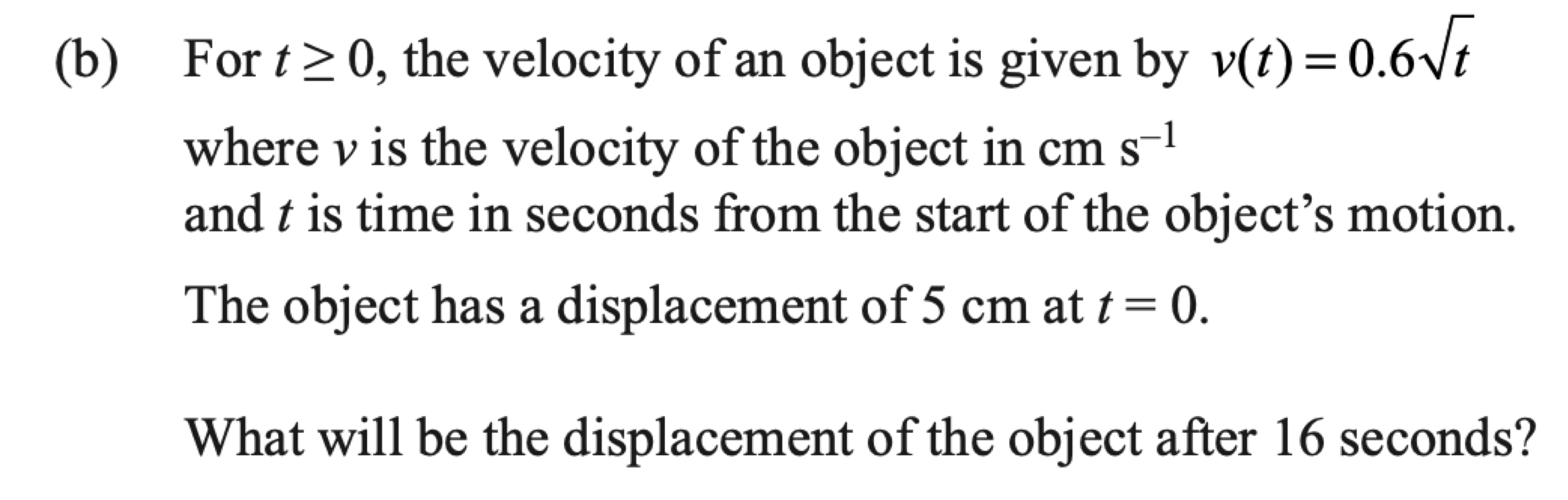
For \(t\ge0\), the velocity of an object is given by \(v(t)=0.6\sqrt{t}\), where \(v\) is the velocity of the object in centimetres per second and \(t\) is time in seconds from the start of the object's motion.
The object has a displacement of \(5\) centimetres at \(t=0\). What will be the displacement of the object after \(16\) seconds?
Hint
First walkthrough idea
Focus to try first
Velocity is the derivative of displacement, so integrate \(v(t)\), use \(s(0)=5\), then evaluate \(s(16)\).
First worked step
Step 1
Integrate the velocity
Rewrite the square root in exponential form before applying the power rule.
Show the first step’s working
Walkthrough overview
What this question practises
This 2020 walkthrough is part of AS91579 — Apply integration methods in solving problems.
Method: Integrating velocity and using the initial displacement.
This is Question 1(b) from the 2020 NCEA Level 3 Integration paper for AS91579 — Apply integration methods in solving problems. Attempt the question independently, then use hints and worked steps to compare your reasoning.
Calc.nz is an independent learning resource. Compare questions, diagrams, and assessment information with the official NZQA resources for AS91579.
Page updated .
Check
Integrate velocity to find displacement and use the given position to fix the constant. Check velocity signs before treating displacement as distance travelled.
More practice and reflection
This walkthrough helps you practise integrating velocity and using the initial displacement. Use the hints to plan the method, then repeat the question without hints and check each step.
Try a related question: 2021 Integration · Q1(b)(i). Attempt it before opening working, then return to this question later.
- All 2020 Integration questions
- AS91579 sources and years
- Practise more questions using this skill: Antidifferentiation